Dashboard Overview
Understanding your dashboard metrics, revenue charts, and recent orders at a glance.
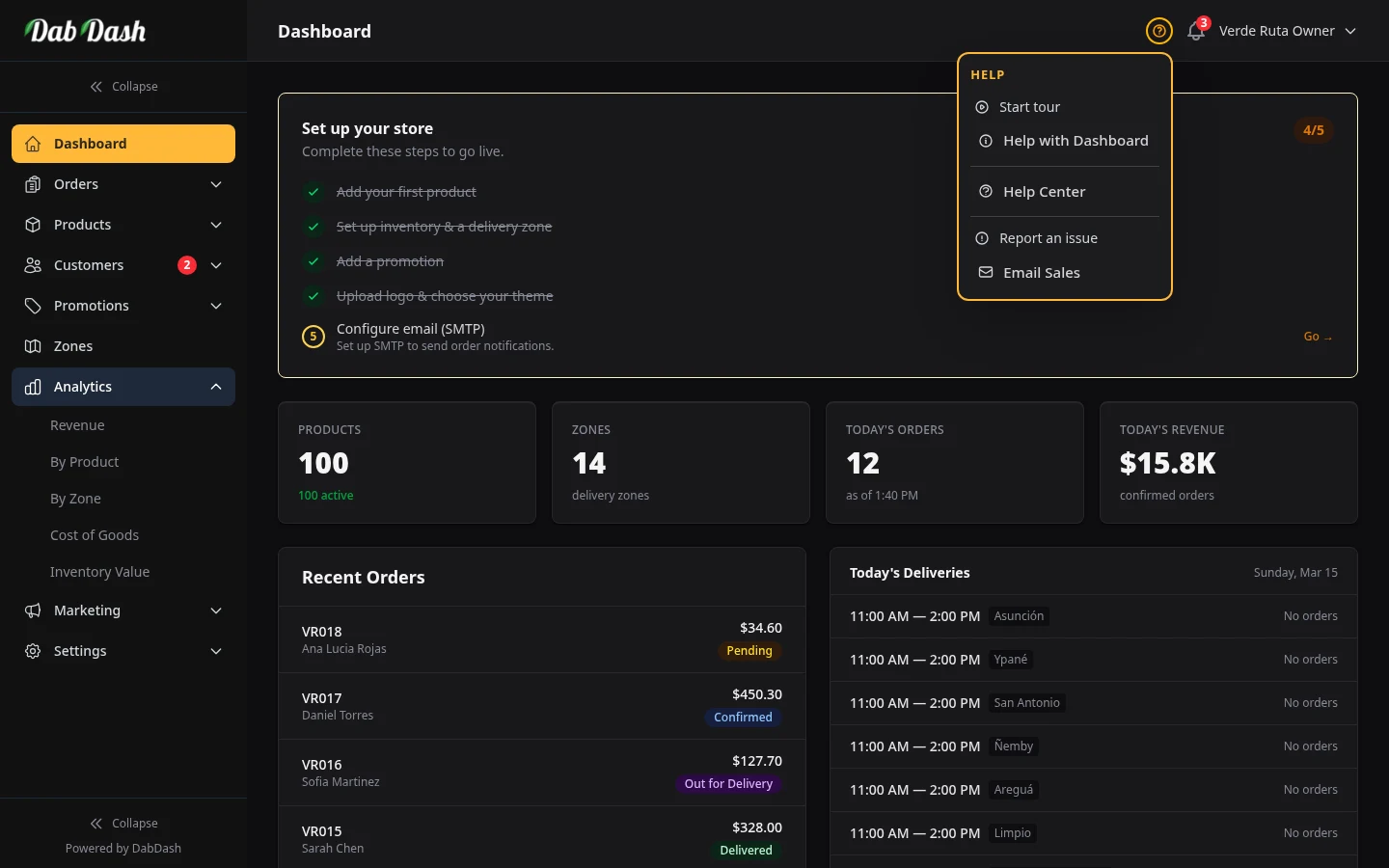
Overview
The Dashboard is the first page you see after you sign in. Think of it like the front counter of your online store: you can quickly see how busy the day is, what needs attention, and where to go next.
If you refresh this page, the numbers refresh too. It is meant for quick daily check-ins, like opening shift and closing shift.
Example Data Banner
Some stores see a yellow message at the top that says you are viewing example data. This is practice data (sample products, sample orders, and sample customers) so you can learn the dashboard safely.
When you are ready to run your real store, use Clear example data. This removes all sample items and keeps only your real setup.
Important: clearing example data cannot be undone. Only click it when your team is ready.
Setup Checklist
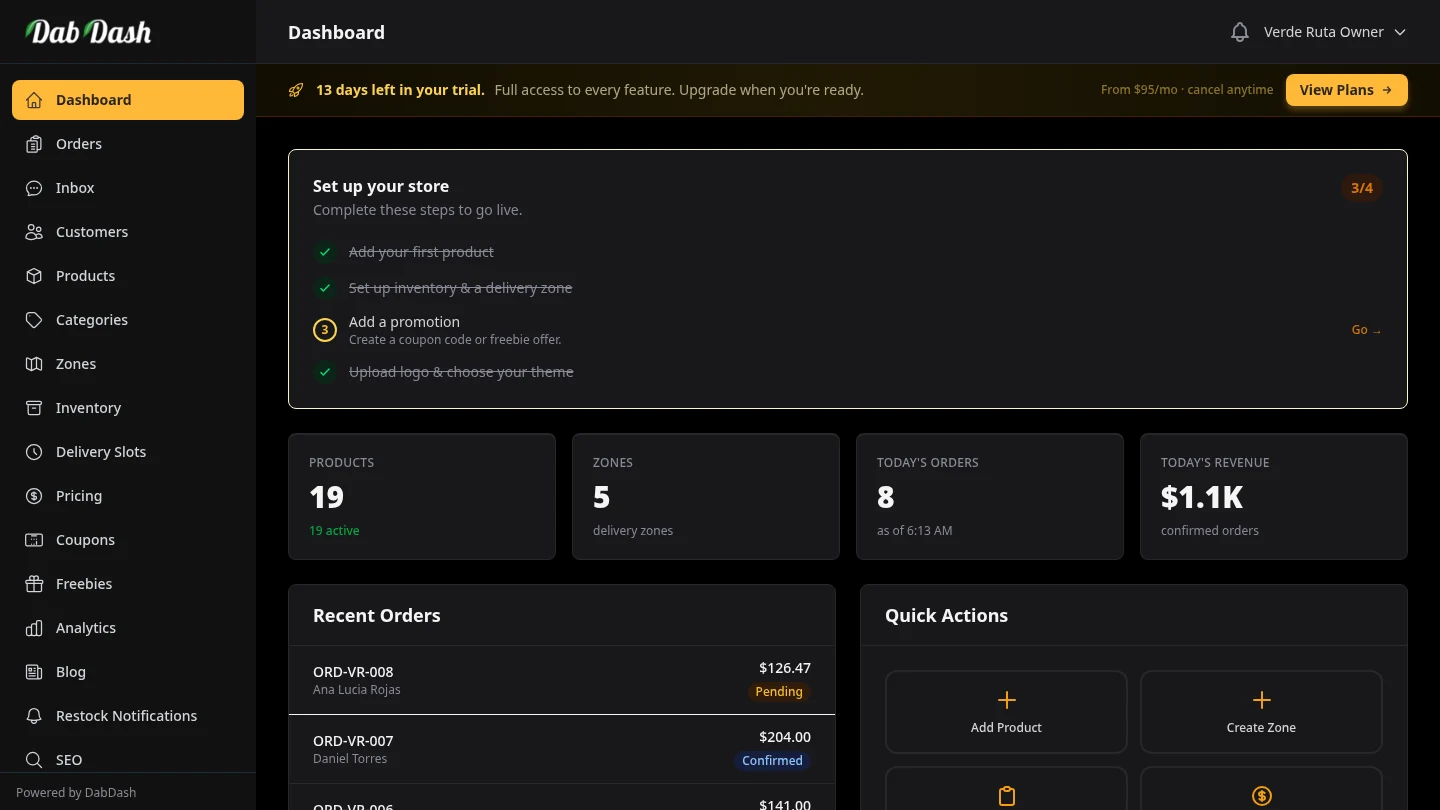
New stores see a Set up your store checklist. Each line has a Go → link that opens the right page.
The badge in the top-right (for example, 3/5) shows your progress. Finished steps get a green check mark.
| Step | What it does |
|---|---|
| Add your first product | Add at least one item with size options and a price so shoppers can place a real order. |
| Set up inventory & a delivery zone | Set your stock amounts and draw your delivery area so checkout can tell shoppers if you serve their address. |
| Add a promotion | Set up a coupon or free gift to help convert first-time buyers. |
| Upload logo & choose your theme | Add your logo and choose your store look so your shop matches your real brand. |
| Set up store emails | Connect your store email sending so customers get order updates and confirmations. |
After all steps are done, the checklist is replaced by a green success banner telling you your store is live.
You can click Dismiss on that banner if you want a cleaner dashboard.
At a Glance Stats
Four number cards sit below the checklist. They help you answer this fast: "How is the store doing today?"
- Products
- Shows total products plus how many are active right now. Active items are visible to shoppers. Inactive or archived items are not.
- Zones
- Shows how many delivery zones you have. If you have none, this card gives you a Create first zone link.
- Today's Orders
- Shows today’s order count and includes an "as of" time so you know when that number was last checked.
- Today's Revenue
- Shows money from confirmed orders today. Large numbers are shortened (for example, $1.1K means $1,100).
Low Stock Alert: if items fall below your low-stock line, a red warning appears with a direct View inventory link.
Recent Orders
The Recent Orders card shows your newest 10 orders. This helps you spot what needs action right now.
If there are no orders yet, you will see a simple No orders yet message.
| Status | What it means |
|---|---|
| Pending | Payment received. Waiting for you to confirm. |
| Confirmed | You've accepted the order. It's in your queue. |
| Preparing | Being packed and made ready for the driver. |
| Out for Delivery | On its way to the customer. |
| Delivered | Order arrived at the customer address. |
| Completed | Order is fully closed on your side. |
| Cancelled | Order was stopped before delivery. |
| Refunded | Customer payment was returned. |
Use the full Orders page when you need full order handling, like status updates, invoice printing, packing slips, refunds, and exports.
Quick Actions
These are fast shortcuts for the jobs most stores do every day.
- Add Product
- Create a new item quickly when a new strain or product line arrives.
- Create Zone
- Draw a new delivery area and set delivery fee plus minimum order.
- Update Stock
- Adjust stock counts when you receive inventory, sell through, or fix a count mistake.
- Set Pricing
- Set your price ladders (for example, 1g, 3.5g, 7g) so product pricing stays consistent.
If low-stock products exist, you may also see a Low Stock list card on the right. It shows each item name, how stock is tracked, and what amount is left.
Navigation
The left sidebar is your main menu for the whole admin. On mobile, tap the ☰ button to open it.
On desktop, you can collapse the sidebar to icons only and expand it again anytime.

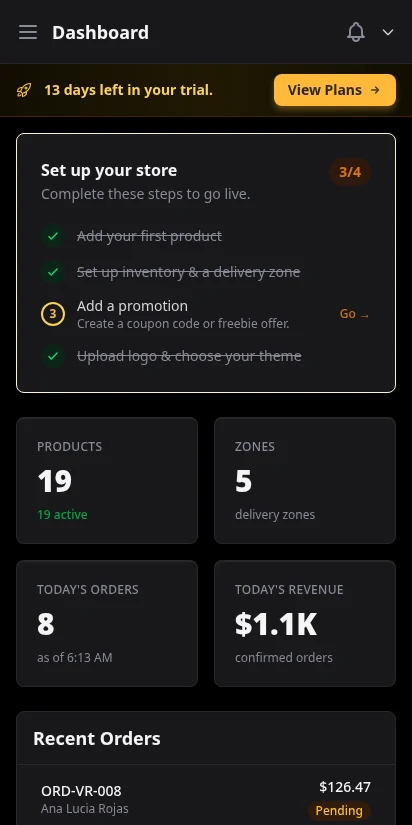
| Section | What's here |
|---|---|
| Dashboard | Today’s store snapshot: setup progress, numbers, recent orders, and quick actions. |
| Orders (group) | All Orders plus Delivery Slots for scheduling. |
| Products (group) | All Products, Categories, Inventory, Pricing, and Restock Alerts. |
| Customers (group) | All Customers and Inbox. Inbox can show unread count badges. |
| Promotions (group) | Coupons and Freebies to drive repeat sales. |
| Zones | Delivery boundaries, fees, and minimum order rules. |
| Analytics (group) | Revenue, by product, by zone, cost of goods, and inventory value views. |
| Marketing (group) | Blog and SEO pages to help your storefront get found and trusted. |
| Billing | Plan and subscription details for your store account. |
| Settings | Store profile, theme, messages, notifications, and account controls. |
Top Bar Controls
The top bar on every admin page gives you fast access to help, alerts, and your account menu.
| Control | What it does |
|---|---|
| ☰ Menu button (mobile) | Opens and closes the sidebar on phones and small tablets. |
| Page title | Shows where you are right now (for example, Dashboard, Orders, or Products). |
| Help button (?) | Opens page help options like tour, article, and full help center. |
| Notification bell | Opens your notifications page. A red badge means unread alerts. |
| Account menu | Opens profile links, settings shortcut, and logout. |
Help & Tours
The ? button in the top-right of every admin page opens a help menu with three options:
- Start tour
- Runs a guided walk-through for the page you are on. It points at each important area and explains what to do. Press Escape to stop anytime.
- Learn the [Page Name]
- Opens the matching help article in a new tab. Example: on Orders, this opens the Orders help guide.
- Help Center
- Goes to the Help Center home to browse all articles by topic.
Auto-start tours: if your store is using example data, the dashboard tour can start automatically the first time. After you finish once, it stays off unless you start it again from the ? menu.