Accept Crypto Payments
Add USDT/USDC on BSC/Polygon/Ethereum, native ETH/BTC/LTC, or USDT on Tron as a payment method. Funds go directly to your wallet — DabDash watches the chain and credits the order once the transfer confirms.
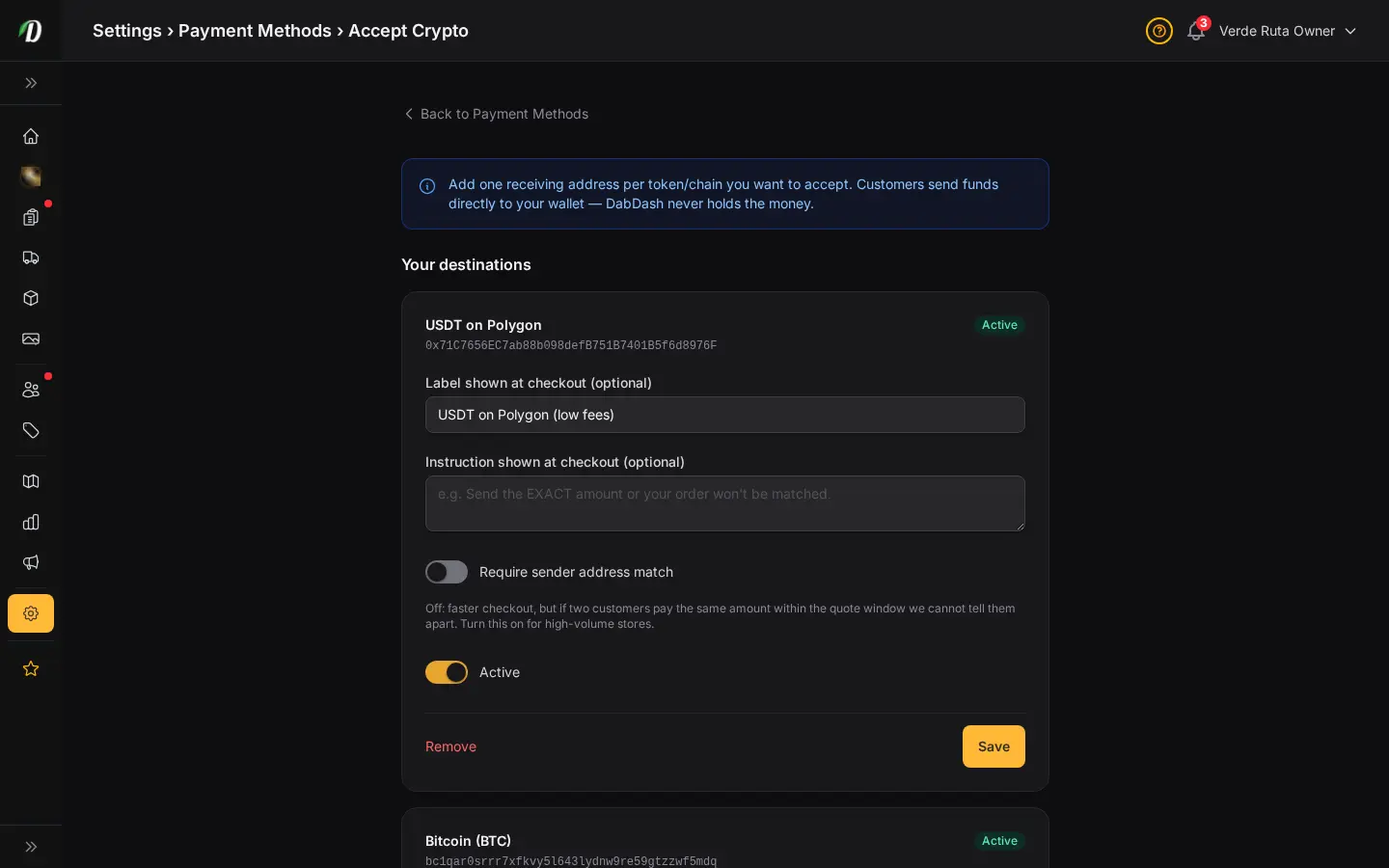
Accept cryptocurrency payments
DabDash lets you accept crypto payments directly to your own wallet. We never hold the funds — the customer sends crypto straight to the address you provide, and we watch the public blockchain to credit the order once the transfer confirms.
Supported networks (all free to verify, no API keys required):
- USDT and USDC on BNB Smart Chain (BEP-20)
- USDT and USDC on Polygon
- USDT on Ethereum (ERC-20)
- USDT on Tron (TRC-20)
- Native Bitcoin (BTC)
- Native Litecoin (LTC)
How it works
- You add one or more receiving addresses on the Crypto sub-page under Settings › Payment Methods.
- At checkout, customers who pick crypto see a sub-radio of your enabled networks, an exact amount to send, and your address.
- The order is created and the address + amount + a 15-minute quote are frozen on it. The customer copies the address into their wallet and sends the exact amount.
- Every minute, DabDash scans the chain for transfers to your address. Once it sees one matching the order's amount, the order flips to detected.
- After enough block confirmations (15 on BSC, 1 on BTC, etc.) the order flips to confirmed and the payment status changes to paid.
Adding a destination
Go to Settings › Payment Methods › Accept Crypto. Pick a network from the dropdown, paste your receiving address from your wallet, and click Add destination. You can add up to 20 destinations per shop.
Address formats are validated against each network's rules:
- EVM (BSC / Polygon / Ethereum):
0xfollowed by 40 hex characters - Tron:
Tfollowed by 33 base58 characters - Bitcoin: legacy
1.../ P2SH3.../ bech32bc1... - Litecoin:
L.../M.../ltc1...
Require sender address match (advanced)
Each destination has an "Require sender address match" toggle. Most shops can leave this off — the watcher matches by amount alone, which is fine for low-to-medium order volume.
Turn it on if your shop has high crypto-payment volume and two customers might pay the same amount within the 15-minute quote window. With the toggle on, the watcher additionally requires the on-chain sender to match a vendor-configured allowlist (managed out-of-band for v1).
What the customer sees
On the order success page, the customer sees:
- The network they picked
- The exact amount of crypto to send (in the token's units — e.g.
35 USDT,0.0008 BTC) - Your receiving address (mono-font, copy-friendly)
- A live status pill that updates every 5 seconds: Awaiting payment → Detected (X conf) → Confirmed
- The quote expiry time (15 minutes from order placement)
Quotes and amount tolerance
We quote USD-to-crypto using CoinGecko's free public API, refreshed every 60 seconds.
Amount matching:
- Stablecoins (USDT / USDC): exact match required. Even 1 unit short = no detection.
- Native tokens (BTC / ETH / LTC): ±0.5% tolerance to absorb gas variance when customers use "send max" in their wallet.
If a customer sends the wrong amount, the order stays in Awaiting payment and the quote expires after 15 minutes. You can resolve under-payments out-of-band by contacting the customer or refunding via your wallet.
Confirmations required per network
| Network | Confirmations | ~Time to confirm |
|---|---|---|
| BSC (USDT/USDC) | 15 | ~45 seconds |
| Polygon (USDT/USDC) | 30 | ~70 seconds |
| Ethereum (USDT) | 12 | ~3 minutes |
| Tron (USDT) | 19 | ~1 minute |
| Bitcoin | 1 | ~10 minutes |
| Litecoin | 6 | ~15 minutes |
DabDash never holds your funds
Funds go straight from the customer's wallet to your wallet. DabDash does not custody anything — we only read the public blockchain to detect incoming transfers.
We never have your private keys. Refunds are vendor-to-customer out-of-band (crypto transfers are final once confirmed).