Price Menus
Configure Simple, By Weight, By Unit, Variation × Weight, and Variation × Unit pricing for cannabis products.
Overview
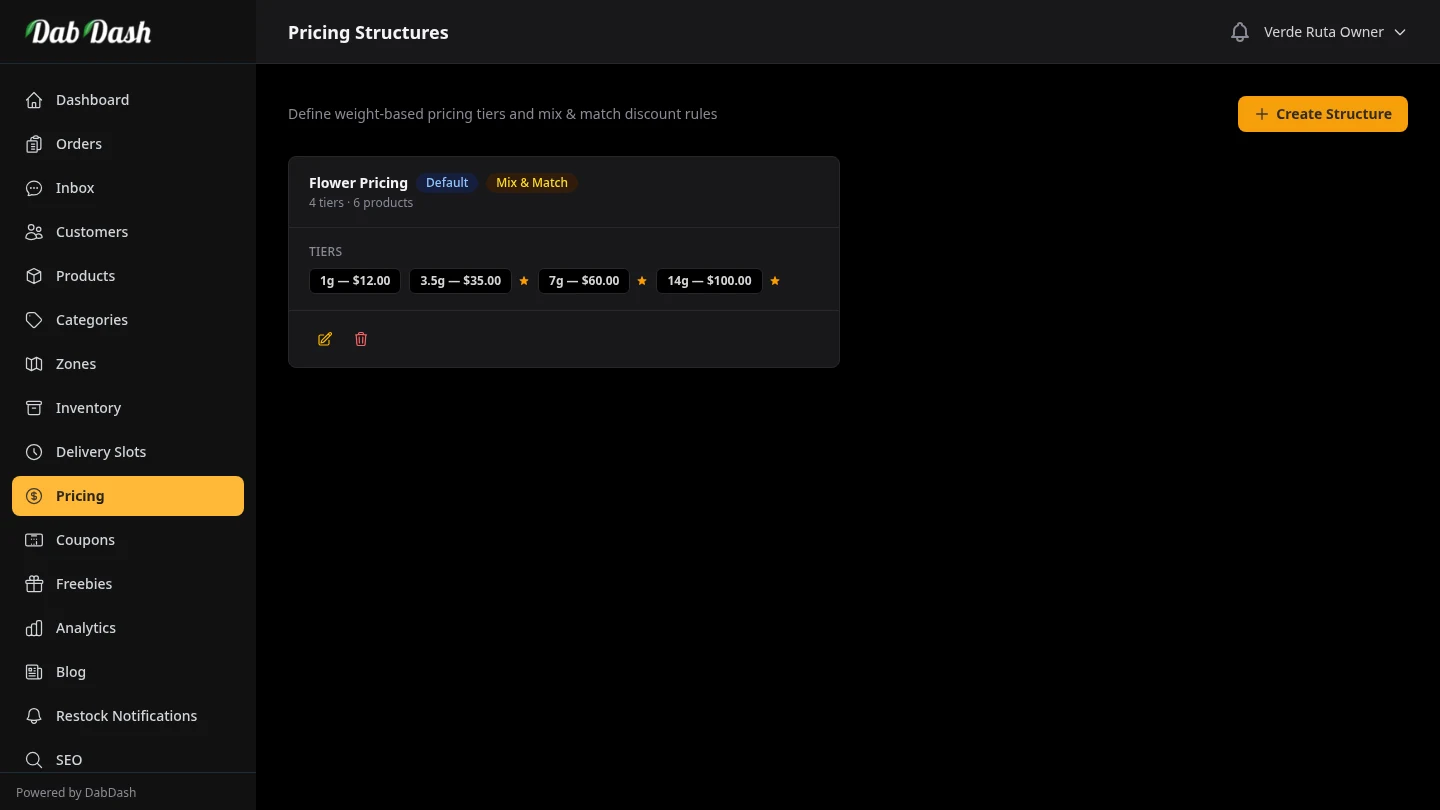
Price menus are reusable pricing templates you assign to products. The Price Menus page shows all your templates as cards. Each card previews:
- Tier pills — each tier appears as a pill showing the weight/unit key and price. Tiers with a sale show the original price crossed out in gray and the sale price in red.
- Sale banner — when any tiers are on sale, a red banner shows "Sale active on X of Y tiers" so you can spot promotions at a glance.
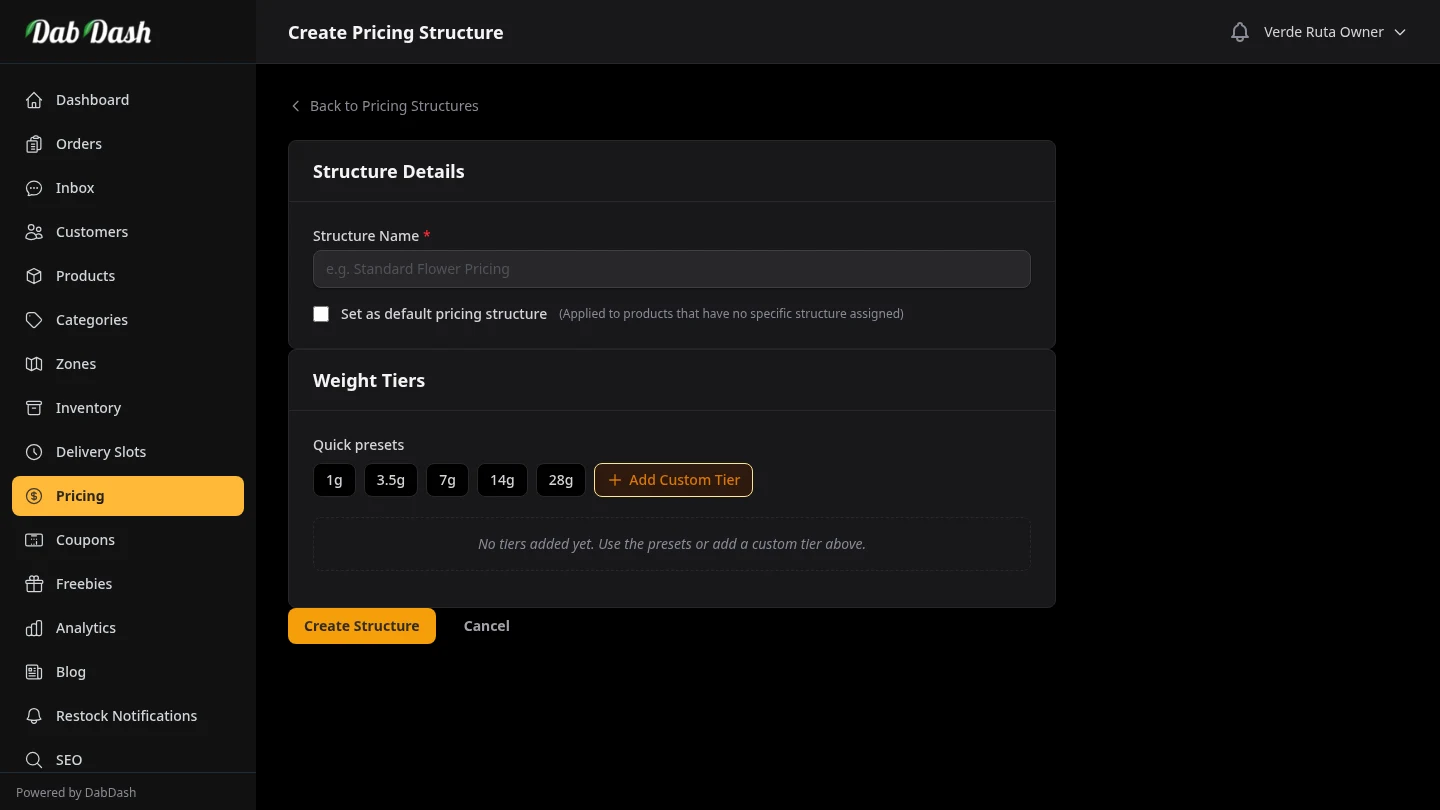
Click Create Price Menu to add a new template, or click Edit on any card to modify its tiers and settings.
Quick Pick
If you only remember one thing: choose the tier type based on how your staff counts stock and how shoppers think about the product.
- Simple — one default option, no selector shown to customers (best for single-option items).
- By Weight — best default for flower and hash.
- By Unit — best for piece-count products (edibles, disposables, pre-roll packs).
- Variation × Weight — for rare cases like flavored hash where each flavor has gram sizes.
- Variation × Unit — for flavor-based unit packs (for example, gummy flavors in 1, 3, 5 pack sizes).
Where To Set This Up
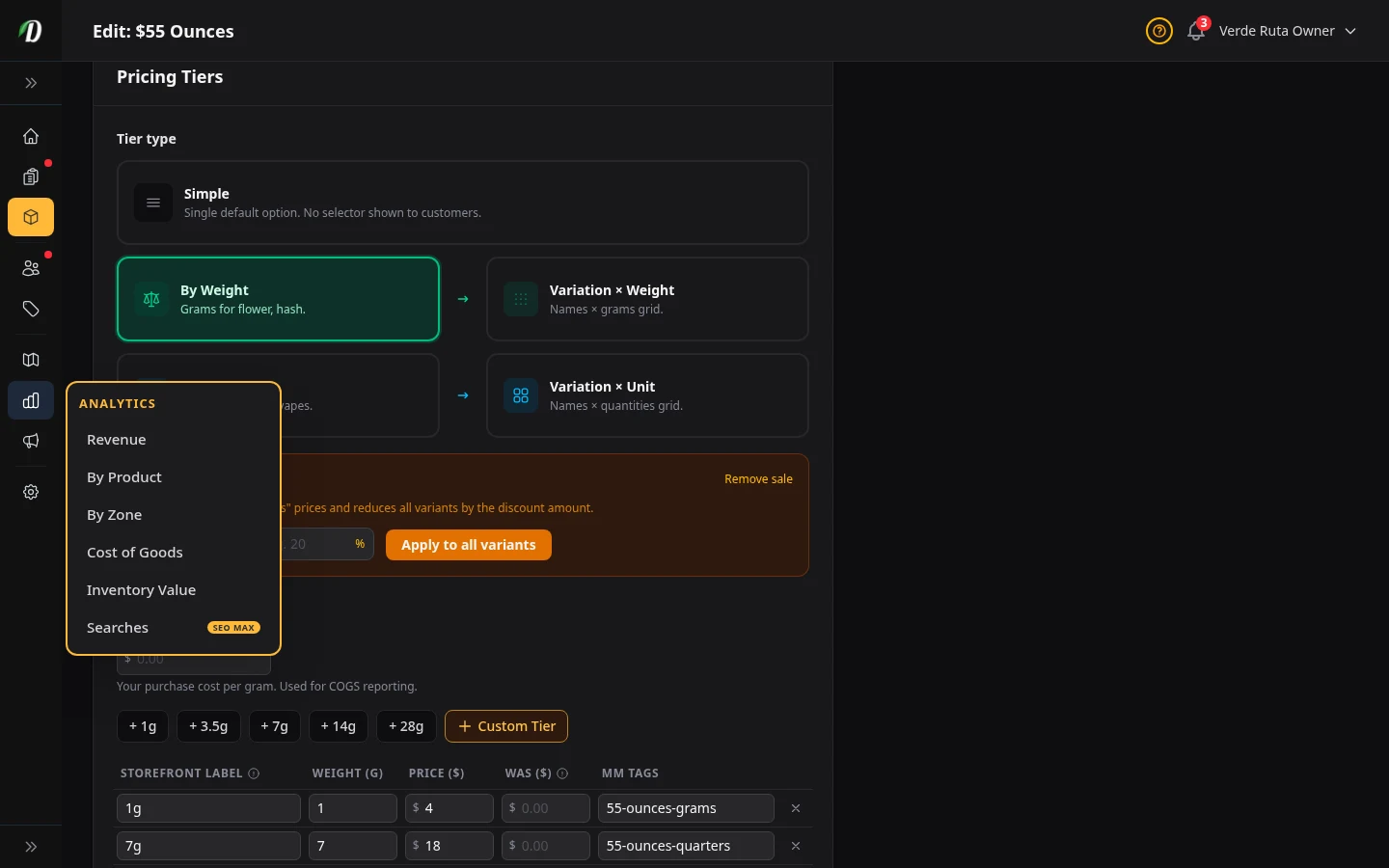

The same five tier types are available in both the Price Menus page and the product form. On product create/edit, DabDash stores your choices in a dedicated price menu for that product.
All Five Tier Types At A Glance
| Tier Type | Best For | Stock and Cost Tracking | Customer Shopping Experience |
|---|---|---|---|
| Simple | Single-option products with one buy choice | Unit-family reporting; one implicit unit variation | No selector shown to customers |
| By Weight | Flower, hash by grams | Tracked by grams; cost reports use grams sold × your cost per gram | Simple gram selector (1g, 3.5g, 7g, etc.) |
| By Unit | Edibles, carts, pieces, packs | Tracked by units; cost reports use per-unit cost | Simple quantity selector (1 unit, 3 units, 5 units) |
| Variation × Weight | Flavor/variant rows with gram columns | Still treated as weight in reports and cost tracking | Two-step choice: variant first, then weight |
| Variation × Unit | Flavor variants sold in unit packs | Still treated as unit in reports and cost tracking | Two-step choice: variant first, then pack size |
1) Simple

Use this for products with exactly one purchasable option. It behaves like unit tracking in reporting, but removes pointless customer selectors.
- Cost tracking: treated like unit-style products in profit reports.
- Inventory: one implicit unit option; no multi-tier selector logic.
- Customer experience: fastest flow — direct Add to Cart.
2) By Weight

Use this when the shopper is choosing grams or ounces. This is the standard setup for flower and most hash menus.
- Cost tracking: one cost-per-gram field shared across all tiers. COGS = grams sold × cost per gram.
- Inventory: stock deductions happen in grams, not item counts.
- Customer experience: clear gram selector — least confusing for flower buyers.
3) By Unit

Use this when products are sold as pieces or packs, not by weight. Good for gummies, disposable vapes, and other single-option items.
- Cost tracking: per-unit cost is set on each tier row for accurate margin reporting.
- Inventory: stock deductions happen in unit counts.
- Customer experience: clear quantity language for non-weight products.
4) Variation × Weight

Use this only when variant identity matters and each variant also has multiple gram options. Example: flavored hash where shoppers choose both flavor and grams.
- Cost tracking: one cost-per-gram field per variation row (behaves like By Weight in reports).
- Inventory: stock tracked per variation label — each flavor is its own gram pool.
- Customer experience: two-step choice: variant first, then weight. More powerful but more complex — use only when needed.
5) Variation × Unit

Use this when shoppers pick a variant (such as gummy flavor) and then pick a unit quantity/pack size. This is the best fit for flavor-heavy edible catalogs.
- Cost tracking: cost per cell (behaves like By Unit in reports).
- Inventory: tracked and adjusted in units per variation.
- Customer experience: clearer than weight for candy/pack products while still supporting variant choice.
How This Affects Profit Reports
Cost of goods (COGS) means your product cost. DabDash uses each order line cost to calculate margin. The tier type decides whether the line is treated as weight-based or unit-based:
- Simple + By Unit + Variation × Unit: cost uses per-unit pricing logic.
- By Weight + Variation × Weight: cost uses the selected weight amount and your cost-per-gram entry.
Tip: always fill in cost prices, or profit numbers will look better than reality.
How This Affects Inventory
Tier type controls the option layout on the storefront. Inventory mode controls where stock is stored:
- Product inventory mode: one shared stock pool for the product (used by By Weight).
- Variation inventory mode: stock tracked per variation row (used by Variation × Weight and all unit types).
For weight-tracked products, adjustments and deductions are in grams. For unit-tracked products, they are in unit counts.
Recommendations For Cannabis Retail
- Use Simple for one-option products. If there is only one buy option, remove extra selectors.
- Default flower and hash to By Weight. This matches how budtenders and customers already think.
- Use Variation × Weight only when variant + grams both matter. Example: flavored hash where each flavor has its own size ladder.
- Use Variation × Unit for flavor-pack products. Example: gummy flavors sold as 1, 3, 5 unit options.
- Use By Unit for non-weight products that still need quantity tiers.
- Keep option counts tight. Too many tiers reduce conversion and slow menu updates.
Where Mix & Match Deals Live
Price menus set the everyday price and cost for each size. They do not hold quantity deals like "buy 4 for 20% off" or "buy 2, get 1 free". Those are Bundle deals, and you create them in one place — the Bundles page in the sidebar.
A bundle picks the product sizes that qualify, sets how many a customer needs to buy, and sets the discount. The deal then applies automatically in the cart when the customer adds a qualifying set — your price menu prices stay untouched.
Good to know: You no longer set deal tags, quantities, or discounts on individual price tiers. Build every quantity deal on the Bundle Deals page so there is one source of truth for each promotion.
Checklist Before Going Live
- Pick one tier type per product family (flower, concentrates, edibles).
- Set cost values where your inventory mode expects them.
- Check one test order in Analytics to confirm margin numbers look right.
- Audit the storefront product page and make sure selectors read naturally to customers.
Frequently Asked Questions
What tier types does DabDash support for price menus?
DabDash supports five tier types: Simple (single flat price), By Weight (price tiers by gram — 1g to 1oz), By Unit (price tiers by pack count), Variation × Weight (product variations each with their own gram tiers), and Variation × Unit (product variations each with their own unit tiers).
How do I set cost prices for profit margin tracking in DabDash?
Edit a price menu and enter the wholesale cost per gram (for By Weight menus) or the cost per unit (for By Unit menus). DabDash uses these cost prices to calculate COGS (cost of goods sold) and gross margin in the Analytics COGS tab. Accurate cost prices give you accurate margin reporting.
Can multiple products share the same price menu in DabDash?
Yes — price menus are reusable templates. Assign the same menu to as many products as you like. When you update a shared menu's prices, all products using that menu automatically get the new prices without editing each product individually.